

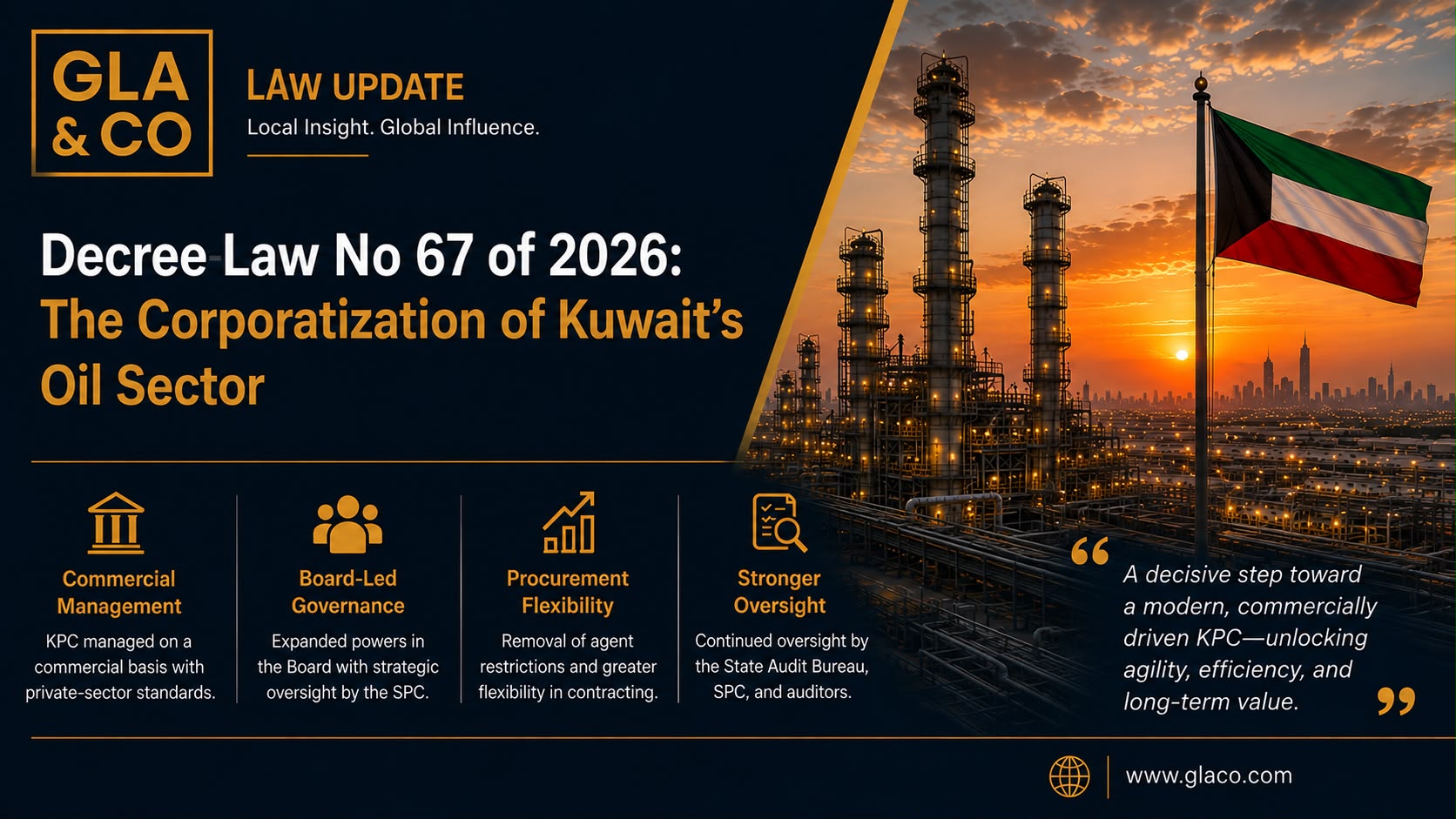
Decree Law No. 67 of 2026: The Corporatization of Kuwait’s Oil Sector
On 28 June 2026, Decree-Law No. 67 of 2026 was published in Kuwait Al-Yawm (Issue 1797), with effect from the date of publication, amending Decree-Law No. 6 of 1980 establishing Kuwait Petroleum Corporation (“KPC”). The amendments revise eleven articles of the establishment law and signal a decisive legislative shift: KPC is to be managed on a commercial basis, governed by a Board empowered to act much like a board of directors under the Kuwait Companies Law (Law No. 1 of 2016), and progressively freed from prior-oversight mechanisms that constrained its contracting and financial operations. This update examines the key reforms and their practical implications for counterparties, investors, and advisors in Kuwait’s energy sector.
From Public Corporation to Commercially Managed Enterprise
Article 1 of the amended establishment law now describes KPC as a “public corporation of an economic character” that is “managed on a commercial basis.” This language is significant. While KPC retains its public-entity status—consistent with Article 133 of the Kuwait Constitution, which guarantees the independence of public corporations under state guidance—the express mandate for commercial management aligns KPC’s governance philosophy with that of private-sector companies.
The explanatory memorandum acknowledges that successive legislation subjected KPC to prior State Audit Bureau oversight and public-tender constraints, impairing the speed and flexibility needed for commercial contracting. The decree removes the application of prior-oversight laws (Law No. 30 of 1964, Law No. 66 of 1998, and Law No. 23 of 2015) to KPC, while preserving subsequent oversight by the State Audit Bureau, supervision by the Supreme Petroleum Council (“SPC”), internal audit functions, and externally appointed auditors.
Critically, KPC has not been converted into a commercial company. The memorandum outlines a two-phase restructuring: the first phase retains KPC’s public-entity form while merging subsidiaries with similar activities; the second envisions transforming KPC into a commercial company managed on purely commercial bases. Decree-Law No. 67 of 2026 principally implements the first phase but lays unmistakable legislative groundwork for the second.
Board-Led Governance and SPC Strategic Oversight
Under the 1980 law, the SPC held broad operational powers—approving regulations, employee rules, tenders bylaws, and subsidiary formation. The amendments redistribute authority. Article 14 now vests in the Board expansive management competencies: approving plans, programs, and projects; setting investment policy; issuing administrative, financial, and technical regulations; approving incorporation of and participation in companies; appointing boards of wholly owned subsidiaries; approving tendering and contracting bylaws outside the Public Tenders Law; and approving financing subject to SPC consent.
Article 16 narrows the SPC’s role to strategic oversight: approving strategic directions, capital changes, budgets, profit distributions, auditor appointments, and financing. The memorandum emphasizes that administrative and executive competencies should rest with the Board rather than burden the SPC—a governance design closely mirroring the Companies Law, where Article 184 provides that a board of directors may exercise all acts required for running the company in accordance with its objectives, subject to law and shareholder resolutions.
Companies Law Parallels: Holding-Company Logic and Subsidiaries
The decree positions KPC structurally as a quasi-holding company. Article 5 permits KPC to incorporate joint-stock companies wholly owned by it, participate in establishing companies, restructure existing companies including by merger or annexation, borrow and issue bonds with SPC approval, and lend to or guarantee subsidiaries. These powers closely parallel Articles 243 and 246 of the Companies Law governing holding companies—investing in shares, managing affiliates, lending to and guaranteeing companies in which the holding company holds at least 20%, and financing subsidiary operations.
Article 3 further expands KPC’s permissible objects to include renewable-energy provision for KPC and its subsidiaries—subject to Ministry of Electricity, Water and Renewable Energy approval for connecting such output to the national grid—confirming that KPC may carry out activities directly or through subsidiaries. The governance framework—external auditors appointed with SPC approval, corporate governance principles, and consolidated oversight—reflects concepts comparable to Articles 186 and 227–228 of the Companies Law and the holding-company consolidated-financial-statements requirement under Article 247.
Contracting Implications: Agent Ban, Procurement Flexibility, and Foreign Counterparties
Two provisions carry immediate commercial significance. First, Article 22 removes prior-oversight requirements, while Article 14(18) empowers the Board to approve KPC’s own tendering and contracting bylaws for KPC and its wholly owned subsidiaries, except for contracts that remain subject to the Public Tenders Law (Law No. 49 of 2016). This is expected to streamline procurement timelines and increase flexibility for international project-finance and M&A transactions. Second, Article 18 prohibits the use of any local agent or commission agent—in any form, during contract conclusion or execution—in connection with KPC or its wholly owned subsidiaries. The memorandum explains that this aims to reduce costs and mitigate legal risk associated with mandatory intermediaries. For foreign counterparties, this effectively removes a structural barrier to direct engagement with KPC.
Practical Outlook and Takeaways
Decree-Law No. 67 of 2026 does not, by itself, convert KPC into a company governed by the Companies Law. It does, however, move KPC substantially in that direction. The immediate effects for market participants include:
- Faster contracting: removal of prior-oversight laws and Board-level authority over procurement bylaws should reduce approval timelines for major contracts, joint ventures, and financing arrangements falling outside Law No. 49 of 2016.
- Direct engagement: the agent ban opens a path for foreign contractors, service providers, and financial institutions to deal directly with KPC and its wholly owned subsidiaries without local-agency intermediation.
- Corporate restructuring: stakeholders should anticipate further M&A activity as KPC merges subsidiaries with overlapping activities and evaluates full corporatization under the Companies Law in the second phase.
- Governance alignment: lenders and joint-venture partners will benefit from a governance architecture that more closely resembles a commercial holding company, with clearer delineation between strategic oversight (SPC) and operational management (Board).
We will continue to monitor implementing regulations and any further amendments as KPC’s restructuring progresses. For guidance on how these reforms may affect your existing or prospective dealings with KPC and its subsidiaries, please contact our Kuwait office.
Authors: Alex Saleh, Managing Partner and Khaled Al Makhezeem, Associate